What I See
Someone asked me: what is the difference between bancha and hojicha?
It is worth saying what kind of confusion this is. The person was not working from a wrong model. They had no model at all. They had bought a bag labelled bancha and thought it seemed like hojicha, then bought a bag labelled hojicha and thought it seemed like bancha. Both were brown. That was as far as the distinction went.
If you have never seen bancha, this may look like someone else’s problem. It is not. The answer changes what you think hojicha is.
Expert View
The two words answer different questions
Bancha describes the leaf. The Japan Tea Association defines it as tea made from leaves that have grown coarse, from old leaves, from stems, and from leaves picked between the main harvests. Read that definition again and notice what is not in it. Nothing about roasting.
Hojicha describes the finish. It is tea, sencha or bancha or others, roasted over strong heat. Notice what is not in this one either. Nothing about which leaf you started with.
One word is about material. The other is about process. They are not two points on the same line. They are answers to two different questions, and a tea has to answer both.
So why do they overlap
If the two words are independent, they should land on different teas often enough to keep them apart in the shop. They do not. Most of what you meet is both. There are two reasons for that, and neither is linguistic.
The first is physical. Coarse leaf survives strong heat. Young leaf does not. So when a tea is going to be roasted hard, coarse leaf is what you reach for, and coarse leaf is, by definition, bancha.
I learned how sharp that line is by getting it wrong. I once asked a tea farm to roast a top-grade tea for me. They roast constantly: they make and sell their own hojicha, and coarse leaf goes through their roaster all the time. They burned it. Not through carelessness or lack of skill. The only thing that had changed was that the leaf was soft.
The second reason is about taste. Bancha on its own often carries harshness and astringency. Roasting covers that. So the roast is not only something coarse leaf can withstand. It is something coarse leaf benefits from.
Two independent axes, pulled onto the same leaf by physics from one side and by flavour design from the other. What looks like a blurred word is a convergence.
Necessary is not the same as definitional
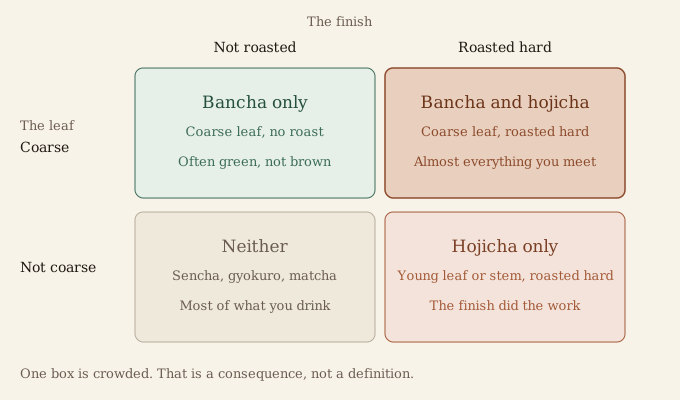
Two axes, four boxes, three of them occupied. The crowded box is a consequence of physics and flavour design, not a definition.
Two axes make four boxes, and three of them have tea in them.
Both bancha and hojicha. This is the crowded box, for the two reasons above.
Bancha but not hojicha. Coarse leaf finished without roasting. In Japanese tea shops, tea sold as bancha is often green rather than brown. If your picture of bancha is a brown tea, this box is the one that corrects it.
Hojicha but not bancha. Sencha roasted hard. Stem tea roasted hard. The leaf was never coarse; the finish did the work.
Neither. Sencha, gyokuro, matcha, most of what you already drink.
The crowded box is crowded for good reasons. But a box being crowded is not what a word means. Bancha does not mean brown, and hojicha does not mean coarse.
What This Case Teaches
The names in Japanese tea are not legal categories. They are working agreements between the industry and regional custom, and they carry the shape of how people actually use them. Perhaps that is why these two blur: bancha and hojicha are so ordinary in Japanese life, so much a part of what is simply on the table, that being understood has mattered more than being precise.
If you go looking for the correct definition of bancha, expecting it to settle whether a given brown tea is one, you will not find your answer. The definition is there. It just is not answering that question.
The question worth asking of a Japanese tea name is not what it means. It is what it is talking about.
Sources
日本茶業中央会「緑茶の表示基準」。番茶およびほうじ茶の定義。
Everything else here comes from our own work.