What I See
I get this question from Japanese customers and from customers abroad, in almost the same words. Matcha, powdered gyokuro, powdered green tea. They look alike. What is the difference?
If you are reading in English, there is a second problem sitting underneath the first one. Matcha is a green tea, and it is a powder. So why is it not simply a powdered green tea?
Because in the Japanese market these are three separate product categories, not three descriptions. The term translated here as powdered green tea means one specific thing: a finished leaf tea that was ground afterwards. Matcha is not that. The English phrase describes a form. The Japanese category describes a route.
That gap is the case. The powder hides the process that made it, and the English name for the powder hides it a second time.
Expert View
Here is the map first. Read it before the explanation, not after.
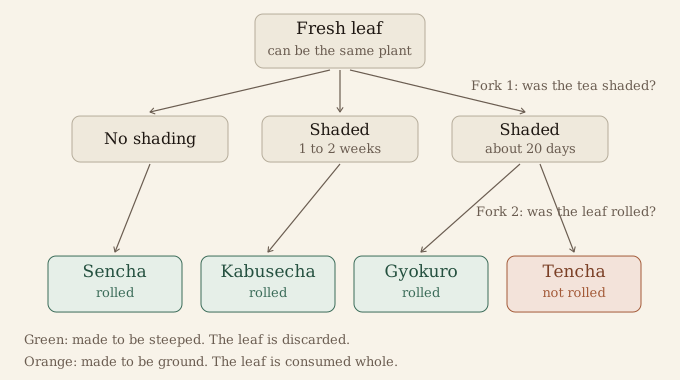
The two forks that decide which tea you get. Neither fork is about origin or cultivar.
Four teas. One plant, one field, one harvest. Two forks decide which of the four you end up with.
Nothing in this map is about where the tea was grown or which cultivar it came from. Two fields side by side, same plants, same day, can produce sencha and tencha. The forks are decisions made by people: whether to put up the shade, and whether to run the leaf through the rolling machines. This is a question of process.
Why it looks like a ladder
The mistake is reasonable. These teas come from the same plant, sometimes the same cultivar. They are all green. They sit at different prices on the same shelf. Everything about the situation suggests a ladder: a cheap version, a better version, a best version.
There is no ladder. There is a map, and these teas occupy different addresses on it.
Fork one: whether the tea gets shaded
Before harvest, some tea fields are shaded. A structure goes up over the field and blocks the sunlight. It stays there for days.
Sencha skips this. The field stays open. Kabusecha is shaded for one to two weeks. Gyokuro and tencha are shaded for around twenty days. The longer the shade stays, the further the leaf moves from what sunlight would have made of it.
Fork two: whether the leaf gets rolled
After steaming, most Japanese green tea is rolled. Rolling breaks down the structure of the leaf so that hot water can pull the components out of it. Rolling is preparation for brewing.
Rolled tea is tea you steep. Hot water draws flavour out of the broken leaf, you drink the water, and the leaf goes in the bin. Most of what was in that leaf never reaches you.
Sencha, kabusecha and gyokuro are all rolled.
Tencha is not. It is steamed, dried flat without rolling, and then ground.
The reason follows from what rolling is for. If the leaf is going to be ground to powder and swallowed whole, there is no extraction step to prepare for. Nothing needs to come out of the leaf, because the leaf itself is going in.
So fork two is really this question: is this leaf going to be steeped and discarded, or ground and consumed?
Where the three powders sit
Now put the three powders back on the map.
Powdered green tea is made by grinding a finished leaf tea, most commonly sencha. Powdered gyokuro is gyokuro, finished as gyokuro, then ground. Both were complete teas before anyone ground them.
Matcha is tencha, ground. And tencha was never a finished tea. It is not sold as a leaf tea in any ordinary sense. Some shops do steep it and serve it, but that is not common practice, and it is not what the process was built for. Tencha exists in order to be ground.
That is the difference. Two of these powders are derivatives of a leaf tea. One of them is the destination.
Then why is powdered green tea the cheap one
If matcha requires twenty days of shading and a dedicated process, that would explain why it costs more. Cheap means less work, and the ladder survives.
It does not survive.
In 2024, aracha for tencha traded at 3,278 yen per kilogram and aracha for sencha at 1,197 yen. Aracha is the semi-finished state, before stems and other material are sorted out. A gap of 2.7 times, before anyone grinds anything. Shading costs money and labour, and it shows up here.
Now look at powdered gyokuro. Gyokuro is shaded for the same twenty days, and it then goes through rolling, which tencha skips. Its process has more steps, not fewer. By the logic of cost, powdered gyokuro should sit above matcha.
It does not. It currently trades at roughly the same level, or below.
Production cost is not what sets these prices. Demand is. Matcha has a global market. Powdered gyokuro has almost none. And the name carries weight of its own: the word matcha is permitted to cost more than the word powdered gyokuro, on powders that started in the same shaded field.
One caution about the cheap one. Powdered green tea is a category, not a quality level. There is expensive powdered green tea and there is very poor powdered green tea. The price gap between matcha and powdered green tea tells you they took different routes. It tells you nothing about where either sits inside its own range.
The question that actually decides it
Someone came to me recently because matcha had become expensive. They had been drinking it daily. Should they switch to powdered green tea?
My answer was not about price. It was a question back: are you whisking it, or dissolving it?
If you whisk it with a chasen, use matcha. Matcha foams and powdered green tea does not, not in the same way. The reason is not a compound in the leaf. A 2010 study separated a single batch of matcha by particle size, with the chemical content of the fractions verified as identical, and the fine fraction foamed several times as much as the coarse one. Matcha is ground far finer than powdered green tea normally is. Fine enough to foam is a property of the grinding, not of the plant.
If you are dissolving it in hot water and drinking it, powdered green tea is fine. The thing matcha does better is the thing you are not asking it to do.
And if catechins are what you are after, powdered green tea tends to have more of them. Catechins increase as the leaf matures, and the shading that defines tencha works against their formation. The expensive powder is not the one carrying more of the compound most people ask about.
Notice what happened to the question. They arrived asking which one is better. The answer had to be: better at what.
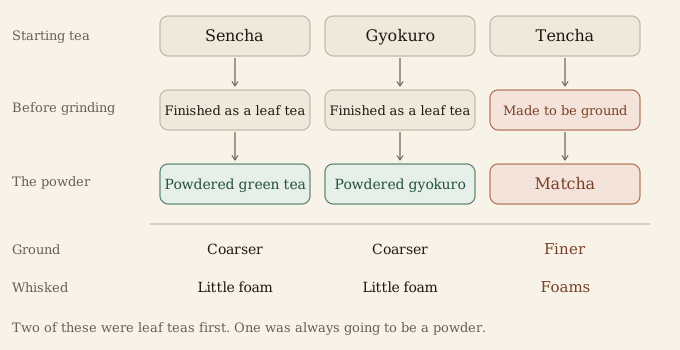
Three green powders, and the routes they took to get here.
What This Case Teaches
These three are not rungs on one ladder. They are addresses on a map, and the map has two forks: whether the tea was shaded, and whether the leaf was rolled.
Once you see that, some familiar questions stop working. Which is higher grade, gyokuro or matcha. There is no answer, because they are not on the same axis. Would grinding an excellent gyokuro give me an excellent matcha. No, and not because the gyokuro is not good enough. It went the other way at fork two, and there is no path back.
Matcha is not the name of a plant or a grade. It is the name of a route.
So the question to ask yourself is not how far up the ladder you can afford to go. It is which route you actually want.
Related Case: I Want Your Best Matcha. It’s for Lattes.
Related Articles: How to Buy Matcha for Lattes: 5 Questions to Ask / Do Not Choose Japanese Tea by Origin or Cultivar Alone
Sources
沢村信一・原口康弘・池田博子・園田純子「粉砕方法の異なる抹茶の物性と形状」日本食品科学工学会誌 57巻7号、2010年、pp.304-309
農林中金総合研究所 山本裕二「抹茶ブームと煎茶高騰 ―転換期にある茶の未来を考える―」2026年5月
Everything else here comes from our own work.